German Clock Museum


Sunday, February 26, 2017

If the Black Forest region of Germany is famous for something, it has to be it's cuckoo clocks! We wanted to learn more about the history of clock-making in the region so we drove to the town of Furtwangen to visit the German Clock Museum.
The morning view from the airbnb. Promising such a lovely day!!
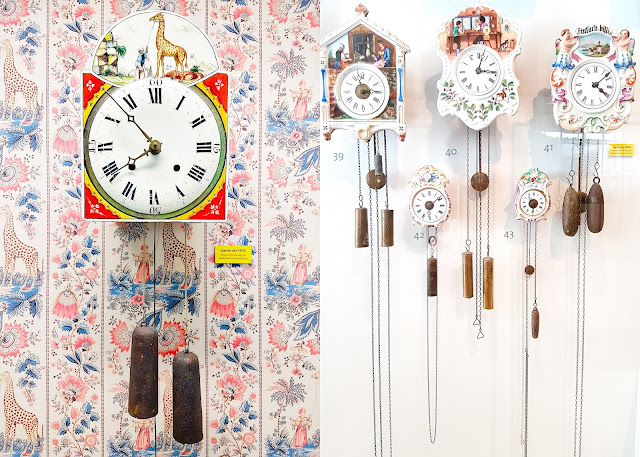
Anybody have the time???
Starting with Stonehenge (which is thought to be a celestial calendar) and early sundials, the exhibit takes in the full breadth of of timepiece history. 
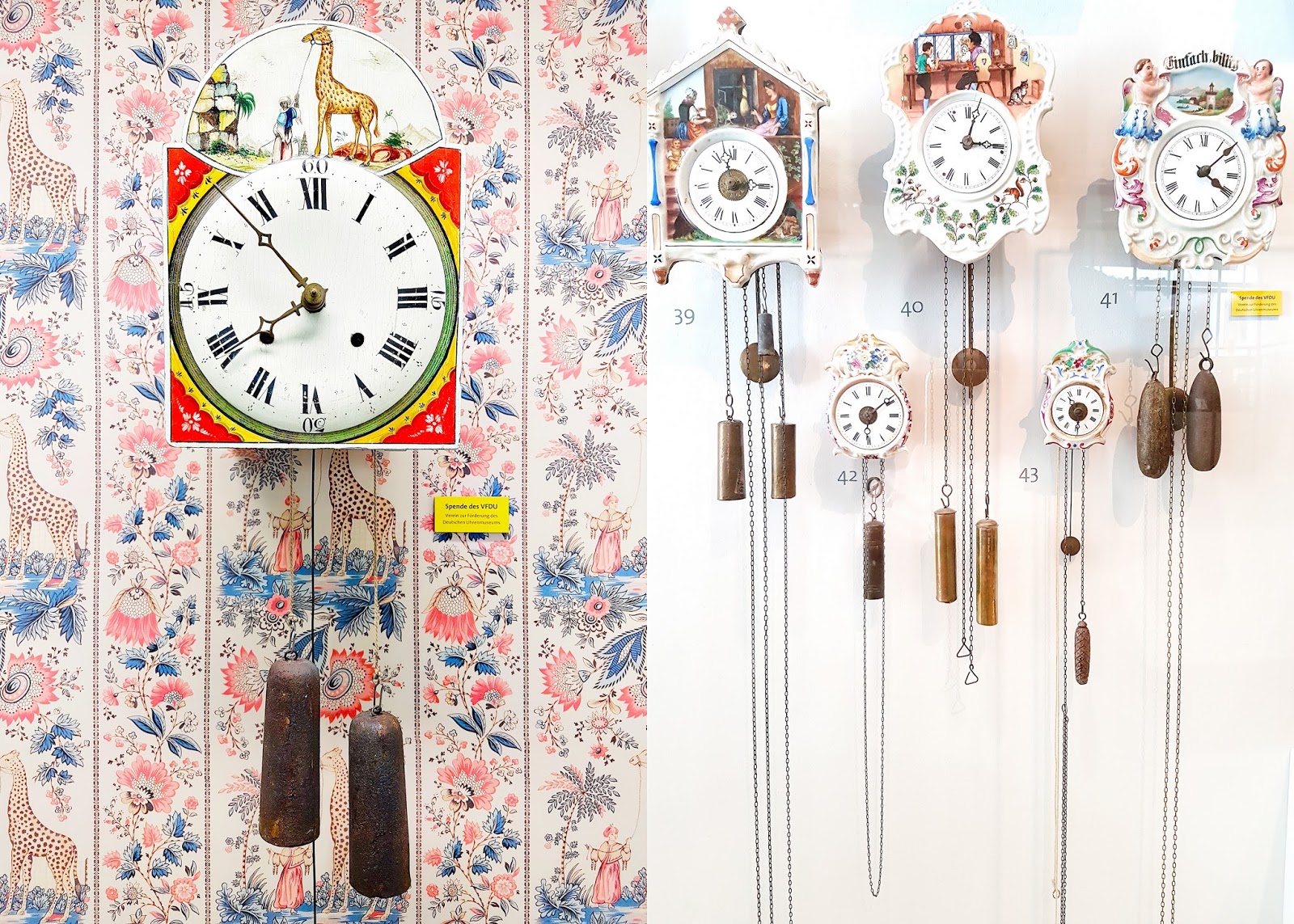
Black Forest clockmakers achieved a breakthrough when they simplified the timekeeping mechanism so that it could be built almost entirely of wood, allowing the clocks to be sold at a much lower price. The museum traced the evolution of these clocks from rough-hewn wood to delicately painted white lacquer faces and into the famous cuckoo style that we all know today.
This lead to a worldwide boom in clock sales. Between 1800 and 1850 alone, 15 million Black Forest clocks were sold around the world.
The exhibit was exclusive about Black Forest clocks, but also looked at clocks from other countries such as these fancy schmancy ones from France.
This gigantic Astronomical World Clock by August Noll was fascinating. It showed the time in several different time zones and has a scene of Jesus blessing the 12 Apostles who shuffle past on the hour.
Clocks of every type, size, shape, and color. 
Jane in front of some awesome midcentury modern clocks.
We had a great time... get it? One of the most fascinating exhibits explained how faster and faster transportation in the late 19th century brought about the need for standardized time across locales. In the past, each town used its own local solar time. As the railroad advanced, this made a wreck of train schedules and connections since different towns and countries were all a few minutes off from each other. When the telegraph was invented, that cemented the need for the world's clocks to be in sync. In the 1870s, scientists finally pursued standardization leading to the creation of the prime meridian as a starting point for the world's time zones in 1884. Isn't it crazy to think that TIME as we know it was only standardized in 1884?
Lovely grandfather clocks down in the demonstration area.
Compilation of short videos from the museum, and a fair warning, it is LOUD at the end!
Our family at the German Clock Museum on Sunday February 19th 2017.
Then we went and picked out a traditional cuckoo clock in Triberg - recap coming next!

Freiburg, Germany


After a fun time in Staufen, our next adventure was to the capital of the Black Forest: Freiburg.

Pretty shot on the drive between the two towns. 
Aren't these doors trippy?
Freiburg is home to 210,000 people, 30,000 of whom are students at the local university.
My people.
Embedded in the cobbles in front of many shops you'll find mosaics made from river stones. These usually represent the type of business the store does. I thought the scissors where a fitting symbol for me.
Admiring some of the other mosaics.
At Rasthausplatz, the old (on the right) and new (on the left) townhalls front the square.
The Church of St. Martin. | Cool Giacometti-esqe statue.
Another view of Rasthausplatz.
The square used to be the enclosed cloisters of the church and you can clearly see that architectural heritage along the periphery of the square.
Shortly after I took the above picture some man started screaming at the top of his lungs in German and wouldn't stop so we high-tailed it outta there... never can be too careful these days...

Eventually we moseyed down to the Münsterplatz where a local market was just finishing up.
This is the main square of the city and holds the bustling market six days a week.
Pretty white and pink granary building.
The main attraction at the square is of course the gorgeous cathedral. The distinctive pink color comes from a soft local sandstone that is easy to work with, but also extremely fragile. The decorations on the building need to be replaced every 30 to 60 years! Keeping the church from falling apart is a never-ending task.
The stained glass windows are originals from the 13th and 14th centuries. These were hidden away and protected during WWII. Good thing, because about 80% of Freiburg's buildings were destroyed by an Allied bombing run during the war.
The colors on the entryway were awesome!
Also on the square is the historic Merchant House. This was the trading and customs center in the 16th century and briefly housed the state parliament after the war.
This line was for a bratwurst stand! Bratwursts are everywhere in Germany, so if you can get Germans to stand in a big ol' line for one, it must be good!
They were selling the distinctive Freiburg lange Rote brats. Delish!
Our silly kids just meandering through old-town Freiburg.
Jane!
So cute.
The absolutely darling Konvikstrasse lined with the little canals called bächle that run along many of the city's streets.
In the spring and summer the street is draped with fragrant purple wisteria.
The Swabian gate, one of two surviving tower gates from the old town wall.
Sharing a pretzel!
The pretty riverside quarter of town. While it was once the smelly tanners' and millers' quarter, now it is a charming low-key neighborhood.
I guess the "love lock" thing hasn't really taken off here yet, lol.
Walking along Grünwälderstraße. 
Craft store! 
We were surprised by how pleasant and fun this city was. Definitely worth a stop if you are traveling in the Black Forest.
After enjoying our day in Freiburg, we loaded up and drove through picturesque German country side to our Airbnb.
A compilation video of walking through Freiburg and the beautiful drive through the Black Forest region of Germany to our Airbnb. We listen to Harry Potter on road trips. We finished book 5 on this trip and started book 6. I think we'll be able to finish the series by the time we leave Germany, we have lots of road trips planned!
Our family in Freiburg, Germany on Saturday February 18th 2017.
Next - a visit to the Clock Museum!
Paige Taylor Evans © // Quinn Creatives DESIGN