The One with the American Crafts KIDS Layout


Tuesday, April 28, 2015

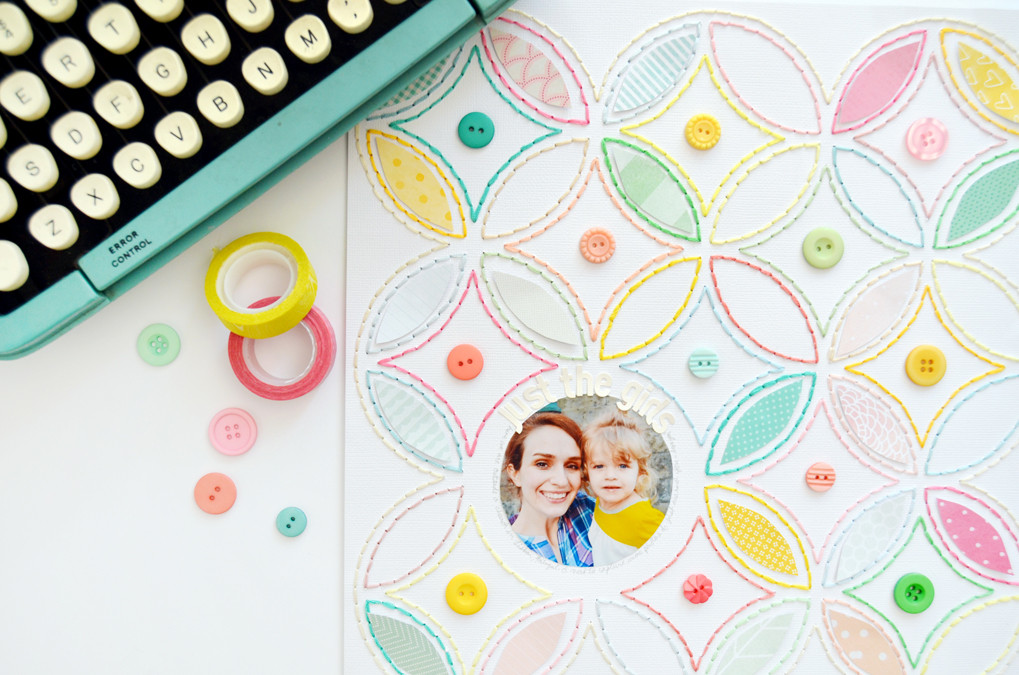
It's KIDS Week on the American Crafts blog and here's what I made for it:
 photo Happy by Paige Evans for blog.jpg
HAPPY by Paige Evans

Description: Inspired by a quilt for this layout! Love how the little fabric pieces translate so easily into patterned paper pieces!

Journaling says: "On Wednesdays we wear pink." - Mean Girls

How to: Trim a sheet of white cardstock into (16) 3" squares. Trim patterned papers (I used the Rise & Shine collection by Amy Tangerine and the Fine & Dandy line by Dear Lizzy) into 1/2" strips. Cover the cardstock squares with adhesive then layer the patterned paper strips across. You have to be systematic about placing dark and light colored papers to create the star. That's where the quilt inspiration came in. Adhere the darker colored squares with foam dots, adhere the lighter squares with regular adhesive onto a vanilla cardstock base. Then trim the eight half/half squares diagonally and adhere the light part with regular adhesive and the dark part with foam squares - this way the entire star pops off the page. Stitch around the star a couple of times using a sewing machine and white thread. Add a photo off-center and embellish to your heart's desire. Journal with a black pen and stamp the date in black ink. Done and done!

Supplies: Cardstock, patterned paper, chipboard, stickers, number paper clip, die cuts, round tag, roller date stamppenadhesive: American Crafts; Ink: StazOn; Sewing machine: Brother; Thread: Coats & Clark
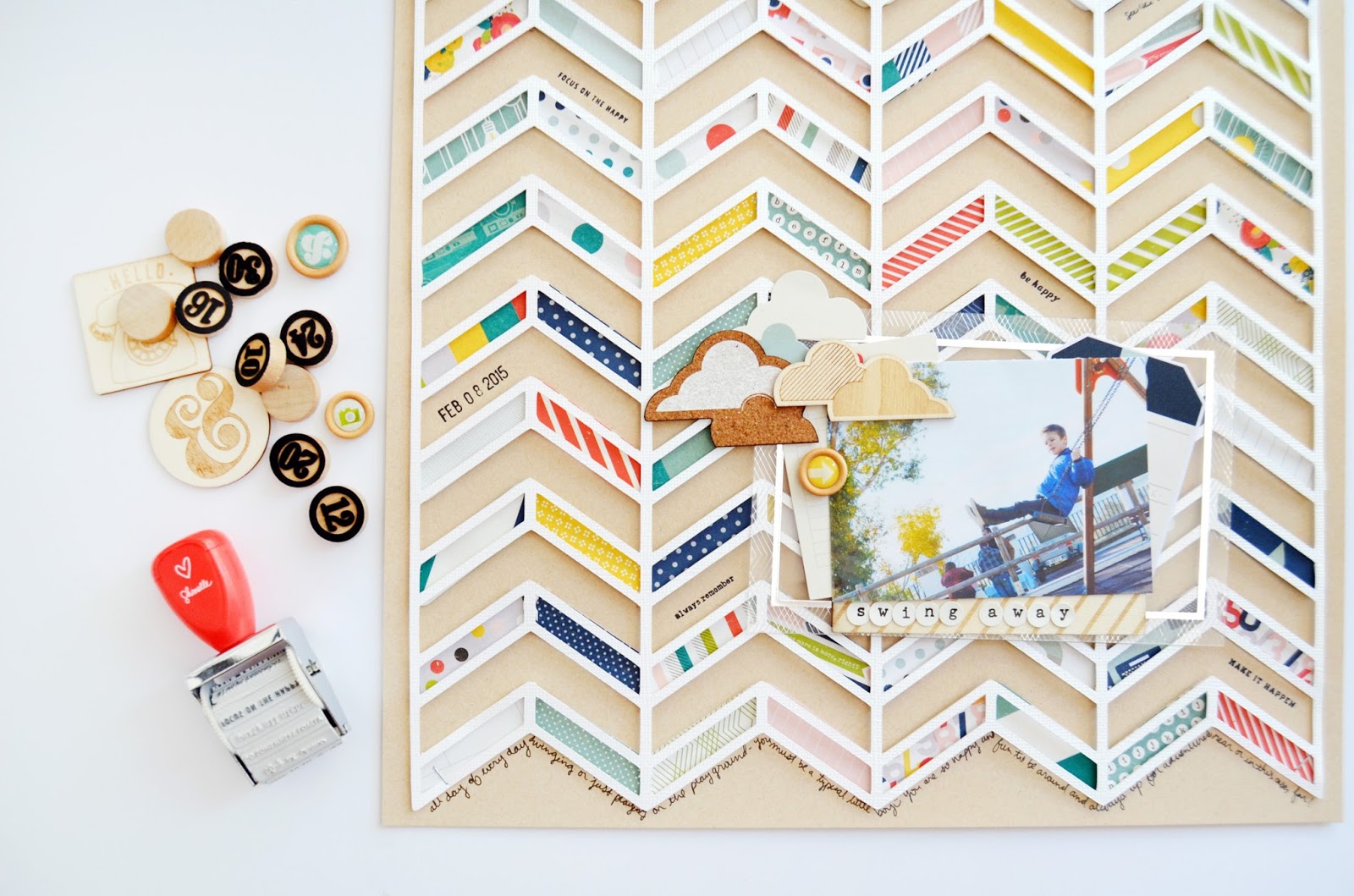
 photo Happy Detail by Paige Evans for blog.jpg
Have I mentioned lately how much I love American Crafts? :)

The One with Big Picture Classes - Paige's Pages 02


Sunday, April 26, 2015


The second round of Paige's Pages at Big Picture Classes is now live, up, and running - squeeeee! (And if you missed it, be sure to check out the first Paige's Pages class too!)


Here is a short description of the class: Paige Evans' layouts often have us wondering - how did she DO that? In Paige's Pages, Paige will be sharing the inspiration and techniques she uses each time she starts a layout, and challenging you to look at your supplies in a whole new way."

Big Picture Classes (or BPC) is an online learning platform for all things crafty, offering classes that cover all the crucial topics about crafting, creating, and documenting memories that you'll need to excel, and then some! Get access to as many classes as you want for only $9.95 a month - that's an AWESOME deal! Each class brings you a variety of topics and ideas, not to mention videos, PDFs, prompts, and so much more! Check out the Big Picture Classes website to find out more about how you can learn everything you need to know to document your memories beautifully every time!
In Paige's Pages #2 (AND Paige's Paiges #1!) there are four start-to-finish videos, more examples of layouts at the end of each lesson, and I'm available here or there for any questions you may have! I love teaching, I love making scrapbook videos, and I'd LOVE to see you in the Paige's Pages #2 classroom over at Big Picture Classes!

The One with KreativWerkstatt


I'm jumping around a bit, but on the way home from The Netherlands/Belgium, Chris and the kids dropped me off in Frankfurt to teach at KreativWerkstatt for Heidi Swapp! She's been traveling a lot and has a bunch of events in April and couldn't make it out to Germany - I was so glad the timing worked out perfectly! All I had to do was show up and teach - the kits were already made and the mini album was completed. Win win!
But first - breakfast! Bread and cheese of course :)
And some cereal - you know I love me some cereal!
There were 6 groups with about 13-15 ladies in each class.
All prepped and ready to go!
Workin' hard on misting and gluing.
Loved seeing how each person's album turned out differently.
Here's the album I made based off of Heidi's:
On the way home I navigated the Deutsche Bahn solo. Gotta love German efficiency. The train was supposed to arrive at 12:26 and at 12:26 it pulled in! That's how it was with all the stops and transfers. So awesome.
The Hauptbahnhof in Frankfurt.

5 hours of riding along gorgeous German countrysides. It was heaven!
Such a fun opportunity - there's even talks of me teaching my own class next year!!

The One with Amsterdam, The Netherlands


Friday, April 24, 2015

On Sunday April 12th 2015 we hopped in the car and pointed our GPS to The Netherlands!
About 6 hours later we arrived. Kinda.
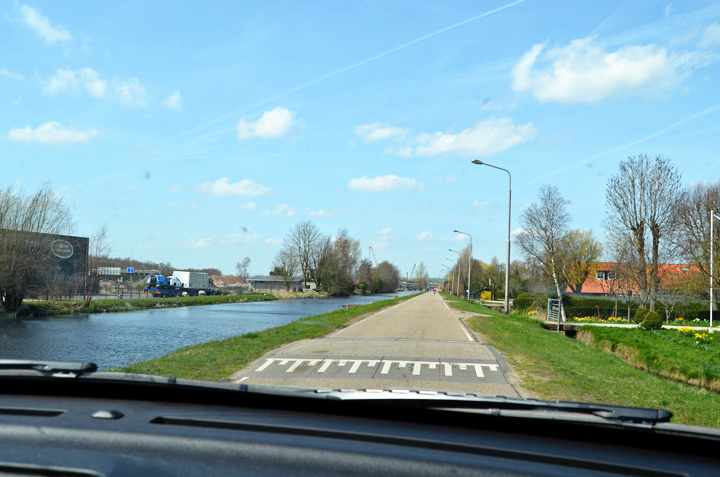
There was traffic so our GPS diverted us to a road that we were 100% sure was not actually a road for cars (why GPS, WHY?!) but then we saw cars driving in front of and behind us and ventured on...
Yes, we (I mean, I) rented it solely for the pink couch.
The interior decor and design was super awesome and inviting.
Our airbnb host recommended a great parking lot right by the main train station (which was where our planned Rick Steves' walk started) so we plugged in the address to our GPS, found it no problem, parked, and headed out to explore the city.
Our first glimpse of the city! The basilica of St. Nicholas.
We walked along the water to Central Station to begin our walk. Amsterdam today looks much as it did in its Golden Age, the 1600s. At that time it was the world's richest city and an international sea-trading port. Wealthy burghers built a city upon millions of pilings, creating a wonderland of canals lined with trees and townhouses topped with fancy gables. Today's Amsterdam is a city of 820,000 people (and almost as many bikes). It's a city of good living, great art, stately history, and a spirit of live and let live.
Amsterdam is also a bold experiment in freedom and for centuries the city has taken a tolerant approach to things other places forbid. Prostitution is allowed in the Red Light District and "smartshops" sell psychedelic drugs and marijuana is openly sold and smoked. Classy.
Leaving the beautiful Central Station we headed down Damrak street.
The architecture of Amsterdam is divine. The buildings are all so interesting to look at, especially with the added fun of them being crooked and skiwampus. 
Damrak was once a riverbed. It's where the Amstel River flowed north into the Ij, which led to a vast inlet of the North Sea called the Zuiderzee. It's this unique geography that turned Amsterdam into a center of trade. Boats could sail up the Amstel into the interior of Europe or out to the North Sea to reach the rest of the world. Nowadays, the marina is lined with old brick buildings capturing a bit of the 1600s Golden Age.
We passed by the modern stock exchange at Beursplein square. This exchange is a joint venture by France, Belgium, and the Netherlands to compete with Britain's juggernaut stock exchange.
This is the old stock exchange building that was turned into a cultural center in 1984. It's built on (like almost every building in the city) a foundation of pilings - some 5,000 tree trunks hammered vertically into the soil.
A little further down Damrak is the historic heart of the city, Dam Square. The city got its start right here in the year 1250 when fishermen in this marshy delta settled along the built-up banks of the Amstel river. They built a dam blocking the river creating a small village called "Amstel-damme." With access to the sea the fishermen were soon trading with German riverboats traveling downstream and with seafaring boats from Stockholm, Hamburg, and London. Land trade routes converged here too and Dam Square was the center of it all. Today, Dam Square is still the center of Dutch life and is home to the Royal Palace, one of four official residences of King Willem-Alexander.
Next to the Royal Palace is the New Church which is only 100 years newer than the old church and is still 600 years old. The church's interior is often occupied by art exhibits that change every couple of months. It was closed for renovations or something.
A Madame Tussauds. We went to the one in LA. It was fun, and a little creepy. Some of those wax figures are too lifelike.
Get it? "Dam" Good Coffe? Hardy har. :)
Across form the Royal Palace on the square is the National Monument, a white obelisk built in 1956 as a WWII memorial. The Nazis occupied Holland from 1940 to 1945; in those years they deported 100,000 Jewish Amsterdammers, driving many - including young Anne Frank and her family - into hiding. Near the end of the war the "Hunger Winter" of 1944-1945 killed thousands of Dutch and forced many to survive on little more than tulip bulbs. The monument, with its carvings of the crucified Christ, men in chains, and howling dogs, remembers the suffering of that grim time. 
Before we came on this trip Chris said his goal was to get as many fries, waffles, and chocolates as he could. Despite the fact that it was only about 9:30 in the morning, we found a fry shop and got our first, but certainly not last, cone-o-fries. Delicious. | Our next stop was the so-called Hidden Church on Kalverstraat. 
While it's not exactly hidden, it keeps a low profile because it dates from an era when Catholics in Amsterdam were forced to worship in secret. In 1578 Protestant extremists took political control of the city and expelled Catholic leaders and bishops. Catholic churches were stripped of their decoration and for the next two centuries Amsterdam's Catholics were driven underground. Catholics could worship as long as they practiced in humble, unadvertised places like this. 
Today, the church asks its visitors for a mere 15 minutes for God (een kwartier voor God) - an indication of how religions has long been a marginal part of highly commercial and secular Amsterdam.
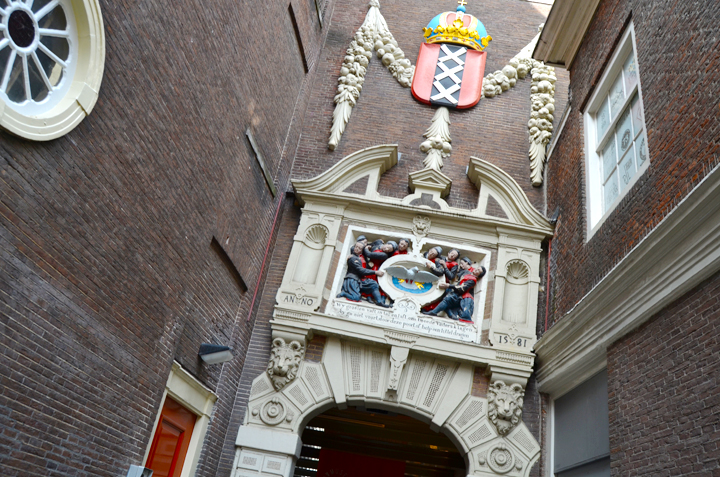
Down from the church is the entrance to the Amsterdam Museum. On the arch above the entrance is Amsterdam's coat of arms - a red shield with three X's and a crown. The X-shaped crosses represent the crucifixion of St. Andrew, the patron saint of fishermen. They also represent the three virtues of heroism, determination, and mercy. But, considering the current things Amsterdam is known for, XXX is very fitting as a symbol for the city.
We didn't go in the city museum, but we want to check out the (free) Civic Guard Gallery. This hall features group portraits from Amsterdam's Golden Age. The portraits show the men gathered in their Civic Guard militia units. These men defended Holland, but the Civic Guards were also fraternal organizations of business bigwigs. There is also a portrait of the city's cultural leaders from 2006 posing as Golden Age bigshots.
Fox and Jane perusing the streets of Amsterdam.
Leaving the museum we tucked into a wonderful, hidden courtyard called the Begijnhof. It was perfection.
This quiet courtyard lined with houses around a church has sheltered women since 1346. This was for centuries the home of a community of Beguines - pious and simple women who removed themselves from the world at large to dedicate their lives to God. When it was first established it literally was a "woman's island" - a circle of houses facing a courtyard surrounded by water. 
The Beguines' ranks swelled during the Crusades when so many men took off, never to return, leaving society with an abundance of single women. Later, women widowed by the hazards of overseas trade lived out their days as Beguines. The last Beguine died in 1971 but this Begijnhof still thrives, providing subsidized housing to about 100 single women (mostly Catholic seniors). 
What an incredible place! So peaceful and quiet, but just steps away from the action of Amsterdam. The black building is the oldest building in the city, dating from 1477.
Leaving the courtyard we crossed through Spui, a square lined with cafes and bars.
Could Amsterdam be any cuter?
Back on a main drag called Ronkin we admired the vista.
The small statue is of Queen Wilhelmina (1880-1962) riding daintily sidesaddle. But, in real life she was the iron-willed inspiration for the Dutch Resistance against the Nazis.
The Evans Family in Amsterdam, The Netherlands on Monday April 13th 2015.
Details from Amsterdam.
At Muntplein stands the Mint Tower which once marked the limit of the medieval walled city and served as one of its original gates. In the Middle Ages the city walls were girdled by a moat - the Singel canal. Until about 1500 the area beyond here was nothing but marshy fields and a few farms on reclaimed land. The Mint Tower's steeple was added later in the year 1620 with a plaque marking the year.
While there aren't many places for great views, a nearby shopping mall has a viewing platform.
The elevator was being serviced so I huffed it up the stairs.
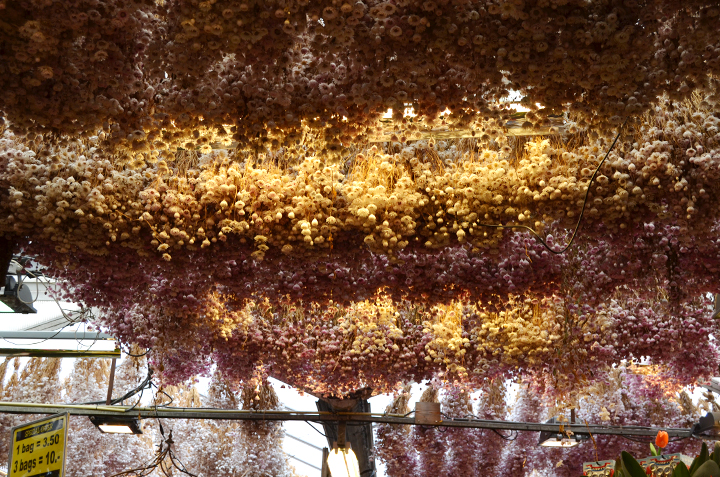
Back on the ground we checked out Amsterdam's famous Bloemenmarket: the flower market. The market is a testament to Holland's long-time love affair with flowers, especially tulips.
When in Holland! I got my self a little bag of mixed tulip bulbs. Hope they bloom!
A bicycle-lined narrow alley across from the flower market.
We moseyed down Leidsestraat admiring the charming buildings.
The "Golden Curve" of the Herengracht canal.
So Amster"dam" cute!
At Leidseplein we saw the Stadsschouwburg - the main theater in the city - designed by the same architect who did Central Station and the Rijksmuseum: Pierre Cuypers.
The Apple Store in what is probably the most expensive piece of real estate in the city.
Our end destination was Museumplein, bookended by the Van Gogh and Rijks museums. We weren't really looking for the famous I AMsterdam sign, but we found it! Plus, with the gorgeous Rijksmuseum in the background and the tulips in the fountain, this was a perfect place to get a family photo. 
Museumplein. 
The line for the Van Gogh museum was suuuuuuper long, so while Chris got in line I walked up to the front to see if they'd let us cut since we have kids and a stroller. Sure enough, they did!
We paid the exorbitant admission price (17.50 euros! EACH!) and entered the museum. On the ground floor was probably the coolest thing we saw in the whole place, one of Van Gogh's actual palettes with some of his paints. Amazing.
My mom loves Van Gogh, so I love Van Gogh, and I loved this museum.
Close up of the iconic sign.
Despite being out and about allllllllll day, we soldiered on and went to the Rijksmuseum.
After paying another exorbitant entrance fee (another 17.50 euros! EACH!) we plunged in.
Figuring out the floorplan was a little complicated, but eventually we made it up to the Great Hall covered in late-Victorian murals. 
Then it was into the Gallery of Honor, home to all the Dutch big shots.
Vermeer.
More Vermeer.
And even more Vermeer!
There are only about 34 Vermeers in existence and this museum has three. All in the same cove. Needless to say, it was packed around those three paintings.
Rembrandt's masterpiece, The Nightwatch. Probably his most famous painting and a revolution in group portraiture. If you only have time for one museum in Amsterdam, I'd go with the Rijksmuseum.
Thus concluded day 1 of Amsterdam. We drove back to our wonderful, peaceful airbnb and recharged for the next day. 
Tuesday morning we spent at the gorgeous Keukenhof Gardens, but then we drove back into the city for the afternoon to explore the Jordaan neighborhood. The walk started back in Dam Square so we parked in the same garage and headed down Damrak from the train station.

The Maggie Holmes buildings :)
So happy to find these! They're right outside Central Station, FYI.
This is the Magna Plaza, a shopping center built in 1899 atop 4,500 wooden pilings. Until the 1980s this was Amsterdam's main post office, but now houses over 40 stores.
The wonderfully crooked buildings on Molsteeg street.
The hooks on the gables were for lifting cargo. The houses even purposefully lean over the street so the facade doesn't get banged up as your IKEA couch is hoisted up.
Torensluis bridge is a square-like area with cafes and charming vistas. Much more relaxed than the crowded Dam Square.
A large bust of Multatuli, a Dutch writer, overlooks the bridge.
We had no plans to tour the Anne Frank House, but we wanted to go see it so we meandered in that general direction, passing by the "Homomonument," Amsterdam's AIDS memorial made up of several pink triangles.
A public "restroom." It is just a shielded area with drains on the ground that people pee in. It smelled so bad.
A nearby fry stand had creative artwork incorporating fries into famous works of art. Here is Van Gogh's The Potato Eaters. Hey, that totally works!
The lovely Westerkerk, or Western Church. 
The inside is pretty Spartan in typical Dutch Reformed style, but there were touches of embellishment.
The organ. 
Somewhere under one of these stones lie the remains of Rembrandt. No one knows which one though so I tried to get a photo of as many as I could.
Lovely riverboat.
Jane loving Amsterdam!

Eventually we wound up at the Anne Frank House. Line much?
Walking across the bridge to the other side of the canal we got a good view of the museum. I kind of wish they had maintained the exterior how it was when the Frank family hid here, but alas, the exterior was modernized. 
Looking back on the Westerkerk spire was we delved deeper into the Jordaan neighborhood.
Dald - make me a table like this m'kay? :)
Walking back to the car after two fun-filled days.
Bikes, bikes, and more bikes.
We stopped super quickly inside the Basilica of St. Nicholas and admired the stained glass.
So colorful.
One last look at this amazing row of houses!
Next stop: Brussels, Belgium - country #20! But who's counting? :)
Paige Taylor Evans © // Quinn Creatives DESIGN