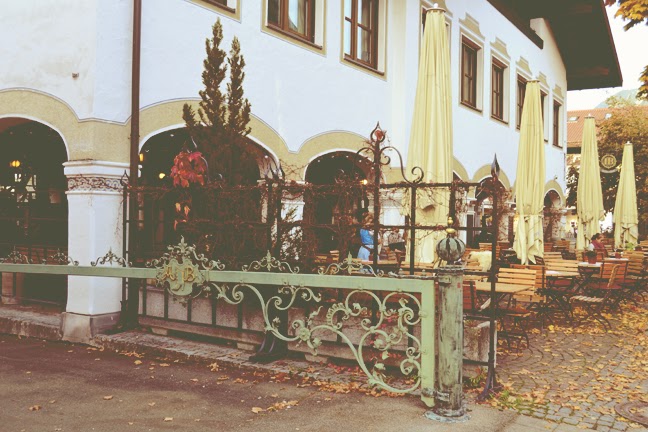
The One with Garmisch-Partenkirchen, Germany


Tuesday, October 29, 2013

After seeing the King's Castles we headed back to our hotel in Garmisch (technically the full name is Garmisch-Partenkirchen) for a little R&R. The views of the mountains along the drive home were incredible.
 Amazing.
 Breathtaking and awe-inspiring!
 The leaves were still hanging on, just for me :)
After resting for a bit, we headed out to see all that we could see in Garmisch-Partenkirchen. I spy a hang glider!
Garmisch-Partenkirchen is a mountain resort town in Bavaria, southern Germany. It is the administrative center of the district of Garmisch-Partenkirchen, in the Oberbayern region, and the district is on the border with Austria. 
Garmisch (in the west) and Partenkirchen (in the east) were separate towns for many centuries and still maintain quite separate identities. Partenkirchen originated as the Roman town of Partanum on the trade route from Venice to Augsburg and is first mentioned in the year AD 15. 
 The main street, Ludwigsstrasse, follows the original Roman road. Garmisch is first mentioned some 800 years later as Germaneskau ("German District"), suggesting that at some point a Teutonic tribe took up settlement in the western end of the valley. 
We had to pause to look at the chickens!
And we stopped to admire these pretty flowers - I want some of the dangling vines in our backyard!
During the late 13th century, the valley, as part of the County of Werdenfels, came under the rule of the prince-bishops of Freising and was to remain so until the mediatization of 1803. The area was governed by a prince-bishop's representative known as a Pfleger (caretaker or warden) from Werdenfels Castle on a cliff north of Garmisch. 
 The discovery of America at the turn of the 16th century led to a boom in shipping and a sharp decline in overland trade which plunged the region into a centuries-long economic depression. The valley floor was swampy and difficult to farm. Bears, wolves, and lynxes were a constant threat to livestock. The population suffered from periodic epidemics, including several serious outbreaks of bubonic plague. Adverse fortunes from disease and crop failure occasionally led to witch hysteria. Most notable of these were the notorious trials and executions of 1589-1596, in which 63 victims - more than 10 percent of the population at the time - were burned at the stake or garroted. The castle Burg Werdenfels, where the accused were held, tried, and executed, became an object of superstitious horror and was abandoned in the 17th century.
Garmisch and Partenkirchen remained separate until their respective mayors were forced by Adolf Hitler to combine the two market towns in 1935 in anticipation of the 1936 Winter Olympic games. Today, the united town is casually (but incorrectly) referred to as Garmisch, much to the dismay of Partenkirchen's residents. Most visitors will notice the slightly more modern feel of Garmisch while the fresco-filled, cobblestoned streets of Partenkirchen offer a glimpse into times past. 
We came, we saw, we conquered. 
Garmisch-Partenkirchen - you are a beautiful town and I hope to grace your presence again, maybe when it's snow-covered?!

Back at the hotel we ate a buffet dinner at one of the restaurants. 
I thought it was good! Lots of people told us the food would be sub-par, but anything I don't have to cook is yummy in my book!
 Nice and homey atmosphere.
After dinner we went swimming! Fox LOVED it. Jane was splashing around in her life jacket, cute as can be. 
We checked the weather for the next day and it looked like a gorgeous morning so we planned to go up to the top of Zugspitze - the tallest mountain in Germany!

The One with the King's Castles: Hohenschwangau and Neuschwanstein


Monday, October 28, 2013

Ever since we learned we were moving to Germany people kept telling us we HAD to go see Neuschwanstein Castle. I'm a big fan of castles, always have been, so I was super excited when we planned this trip to southern Bavaria. We left the hotel at 7am in search of breakfast and to get to our tour on time. We drove through the gorgeous Alps in Austria.

We found a McDonald's in Füssen and ordered at the drive-thru but they never came to the window to take our money. We just sat there at the open window for literally 10 minutes. No one ever acknowledged us. It was so weird! So we left and got some muffins and soft pretzels at the bakery at the ticket office.

And then, we rounded a corner, and THERE IT WAS - NEUSCHWANSTEIN CASTLE! In all its glory! What a sight to behold! Pictures will never do this thing justice. Today, with 1.3 million visitors per year, Neuschwanstein is one of the most popular tourist destinations in Europe.
To the right we saw Hohenschwangau (hoh-en-SHVAHN-gow)! Such an awesome castle as well, if only it weren't right next to Neuschwanstein :)
The otherworldly "King's Castles" of Neuschwanstein and Hohenschwangau capture romantics' imaginations. The older Hohenschwangau, King Ludwig's boyhood home, is less touristy, but more historic. The more dramatic Neuschwanstein (which, yes, I know I know I know, inspired Walt Disney), is the one everyone visits. With fairy-tale turrets in a fairy-tale alpine setting built by a fairy-tale king, these castles are understandably a huge hit.

We made ticket reservations online and they said to pick them up no later than 8:50am. The ticket office didn't open til 9am so that was kind of a conundrum. We were there early with plenty of time to spare and took our time exploring around the bottom of the castles. I wanted to take a horse-drawn carriage up!
Lake Alpsee. Wow.
Fox on a ledge. Pretty vines.

Museum of the Bavarian Kings.
Hohenschwangau Village. Pretty darn picturesque!
We couldn't have asked for a prettier day. So thankful and counting my blessings - it was everything I could have hoped and dreamed and wished for and more!

Walking up the steep stairs to Hohenschwangau. Foxy and my shoesies.


We had time to kill before our tour so we entertained the kids with fountains and fruit snacks.

Janey-girl. She was so happy before the tour!

Looking out down below to Füssen.

Ripe red berries.
Sit still for a picture! Nope, not happening.
Hohenschwangau village / Füssen through the castle walls / Fountain / Hohenschwangau village

Time for a history lesson :)
Standing quietly below Neuschwanstein, the big, yellow Hohenschwangau Castle was Ludwig's boyhood home. Originally there were three castles on these hills, built in the 12th century, but all of them were ruined by Napoleon. Ludwig's father, King Maximilian II, rebuilt the Schwanstein Castle in 1830 and called it Hohenschwangau. Hohenschwangau, loosely translated as "High Swanland" (hence there are swans everywhere inside and out and all around this town), was used by the royal family as a summer hunting lodge until 1912.

Man, I wish I had a summer home that looked like this!


The outside details of Hohenschwangau.


At 9:50am our tour began! We went inside to a waiting room.
The waiting room / Looking out the window to Neuschwanstein.

Pictures were not allowed inside the castle. But you could take pictures out the windows.


I found some images on the interwebs of the interior, just so you can get an idea of the ornateness of this castle.


Chris had to whisk Jane away outside halfway through the tour. All she wanted to do was "walk" around but we couldn't let her so she screamed and that was that. Thanks for taking one for the team babe :)

SO BEAUTIFUL.
Walking back down to Hohenschwangau village. | The town Maypole.
Here's the picture I posted on instagram of Hohenschwangau castle. Looks kind of spooky with that tree so I thought it fitting for the season!

We had an hour-and-a-half to get up to our tour of Neuschwanstein. It's a 45 minute hike straight up the mountain, an expensive horse-drawn carriage ride up, or a cheap bus-ride up. We opted for the bus.
Fox playing in the leaves. | Walking onto Mary's Bridge over the Pöllat Gorge.

This bridge was quite an engineering accomplishment 100 years ago!

Pöllat River running far underneath Mary's Bridge.

Imagine "Mad" King Ludwig as a boy, climbing the hills above his dad's castle, dreaming up the ultimate fairy-tale castle. Inheriting the throne at the young age of 18, he had the power to make his dream concrete and stucco. Neuschwanstein (noy-SHVAHN-stine, roughly "New Swanstone") was designed first by a theater-set designer (hence it's dramatic appearance) then by an architect. The palace was intended as a personal refuge for the reclusive king. It looks medieval, but it's modern iron-and-brick construction with a sandstone veneer, only about as old as the Eiffel Tower. Built from 1869-1886, it's the epitome of the Romanticism popular in 19th-century Europe. Construction stopped with Ludwig's death (only a third of the interior was finished!!!) and within six weeks the family opened it tourists paying to go through it!!!
Here we are! The Evans family on October 26th 2013 at Neuschwanstein Castle!
During World War II the castle took on a sinister role. The Nazis used Neuschwanstein as one of their primary secret storage houses for stolen art. After the war, Allied authorities spent a year sorting through and redistributing the art, which filled 49 rail cars from this one location alone. It was the only time the unfinished rooms were put to use.
"Mad" King Ludwig (1845-1886) has such an interesting story! A tragic figure, Ludwig II ruled Bavaria for 22 years until his death in 1886 at the young age of 40. Bavaria was weak. Politically, Ludwig's reality was to "rule" either as a pawn of Prussia or a pawn of Austria. Rather than deal with politics in Bavaria's capital of Munich, Ludwig frittered away most of his time at his family's hunting palace, Hohenschwangau. He spent much of his adult life constructing his fanciful Neuschwanstein Castle - like a kid builds a tree house - on a neighboring hill upon the scant ruins of two medieval castles. Vorderhohenschwangau Castle and Hinterhohenschwangau Castle sat on a rugged hill overlooking Schwanstein Castle, two nearby lakes (Alpsee and Schwansee), and the village. Separated only by a moat, they jointly consisted of a hall, a keep, and a fortified tower house. In the 19th century only ruins remained of the twin medieval castles, but those of Hinterhohenschwangau served as a lookout place known as Sylphenturm. The ruins above the family palace were known to the crown prince from his excursions. He first sketched one of them in his diary in 1859. When the young king came to power in 1864, the construction of a new palace in place of the two ruined castles became the first in his series of palace building projects. Ludwig called the new palace New Hohenschwangau Castle; only after his death was it renamed Neuschwanstein. The confusing result is that Hohenschwangau and Schwanstein have effectively swapped names: Hohenschwangau Castle replaced the ruins of Schwanstein Castle, and Neuschwanstein Castle replaced the ruins of the two Hohenschwangau Castles.

View of Germany and Austria from the walk down from Mary's Bridge to the entrance of Neuschwanstein.


Although Ludwig spent 17 years building Neuschwanstein, he lived in it ONLY 172 DAYS!

 Ludwig was a true romantic living in a Romantic age. His best friends were artists, poets, and composers such as Richard Wagner. His palaces are wallpapered with misty medieval themes - especially those from Wagnerian operas. Eventually he was declared mentally unfit to rule Bavaria and taken away from Neuschwanstein. Two days after this eviction, Ludwig was found dead in a lake. To this day people debate whether the king was murdered or committed suicide.
For about two decades the construction site was the principal employer in the region. In 1880, about 200 craftsmen were occupied at the site, not counting suppliers and other people indirectly involved in the construction. At times when the king insisted on particularly close deadlines and urgent changes, reportedly up to 300 workers per day were active, sometimes working at night by the light of oil lamps.

Had it been completed, the palace would have had more than 200 interior rooms, including premises for guests and servants, as well as for service and logistics. Ultimately, no more than about 15 rooms and halls were finished. In its lower stories the castle accommodates administrative and servants' rooms and the rooms of today's administration. The king's staterooms are situated in the upper stories. The anterior structure accommodates the lodgings in the third floor, above them the Hall of the Singers. The upper floors of the west-facing posterior structure are filled almost completely by the Throne Hall. The total floor space of all floors amounts to nearly 6,000 square meters.
Neuschwanstein was not Ludwig II's only huge construction project. It was followed by the rococo style Lustschloss of Linderhof Palace and the baroque palace of Herrenchiemsee, a monument to the era of absolutism. Linderhof, the smallest of the projects, was finished in 1886, and the other two remain incomplete. All three projects together drained his resources. The king paid for his construction projects by private means and from his civil list income.
The construction costs of Neuschwanstein in the king's lifetime amounted to 6.2 million marks (not sure if that's dollars?), almost twice the initial cost estimate of 3.2 million marks. As his private means were insufficient for his increasingly escalating construction projects, the king continuously opened new lines of credit. In 1876, a court counselor was replaced after pointing out the danger of insolvency. By 1883 he already owed 7 million marks, and in the spring of 1884 and August 1885 debt conversions of 7½ million marks and 6½ million marks, respectively, became necessary. Even after his debts had reached 14 million marks, Ludwig insisted on continuation of his architectural projects; he threatened suicide if his creditors seized his palaces. In early 1886, Ludwig asked his cabinet for a credit of 6 million marks, which was denied. In April, he followed Bismarck's advice to apply for the money to his parliament. In June the Bavarian government decided to depose the king, who was living at Neuschwanstein at the time. On June 9 he was incapacitated, and on June 10 he had the deposition commission arrested in the gatehouse. In expectation of the commission, he alerted the gendarmerie and fire brigades of surrounding places for his protection. A second commission headed by Bernhard von Gudden arrived on the next day, and the king was forced to leave the palace that night. Ludwig was put under the supervision of von Gudden. On June 13th 1886, both died under mysterious circumstances in the shallow shore water of Lake Starnberg near Berg Castle.

Here is the picture I instagrammed of the view from Neuschwanstein Castle. What a view! I wouldn't mind seeing this all day every day!
Looking up to Mary's Bridge | Looks like the castle from Beauty and the Beast if you ask me!
During the tour we went up and down more than 300 steps, through lavish rooms based on Wagnerian opera themes, the king's gilded-lily bedroom, and his extravagant throne room that never actually had a throne in it because he died before it was made. We saw 15 rooms with their original furnishings and fanciful wall paintings.

Pictures weren't allowed, but here are some from the internet.

The woodcarved bed is the most detailed thing I've ever seen in my life.


Another view of Germany and Austria with Hohenschwangau sitting prominently in the corner.
More pics because I couldn't narrow them down any more.
If you think Neuschwanstein Castle is over-the-top - imagine what Ludwig's Falkenstein would have been like! Falkenstein was never built because of money reasons and Ludwig's death, but beginning stages and drawings are simply incredible.
From wikipedia: King Ludwig II of Bavaria purchased the Falkenstein ruins in 1883 and commissioned several architects, the first being Christian Jank (the designer of Neuschwanstein) to replace the existing structure with a romantic castle. Jank first created a restrained design, but later envisioned the castle in a dramatic, High Gothic style. Georg Dollmann was employed to produce plans and elevations in the same year based on Jank's design. However, his modest and economical designs displeased Ludwig. The task of redesigning Falkenstein was then given to Max Schultze who was flattered by the royal commission. He not only planned the architecture of the castle in a robber baron's style (a highly simplified version of Jank's sketch), but also began creating the castle's interior design and frescos (in a secular Byzantine style) with the help of August Spieß. Of particular note was Ludwig's bedroom, which was reminiscent of a vast chapel. During this time, in 1884, a road and water lines were made to service the site and a papier-mâché model of Schultze's plan was created. However, Schultze withdrew from the project in 1885. Julius Hofmann and Eugen Drollinger were chosen to succeed Schultze, although they knew that it was unlikely Falkenstein would ever be built. Thus, they made their designs as spectacular and impractical as they wished. Drollinger was working on a plan of Ludwig's bedchamber - redesigned to feature stained glass windows and a mosaic dome - when he learned of the King's death. Ludwig died before work on the castle proper could begin and the many plans for Falkenstein were permanently abandoned. The ruin of Castrum Pfronten on the building site was never demolished.

And then it was time to go back to the hotel. We stopped one more time to say goodbye to Neuschwanstein.

The most lovely castle I ever did see.
And those, my friends, are the King's Castles!
Paige Taylor Evans © // Quinn Creatives DESIGN